
RELEASE DATE: JAN 22, 2026
Centering Artists Making History: New Exhibition at the Weatherspoon Looks at the Impact of Experimental Art
Greensboro, NC: Sometimes, it is easy to see history being made—a rocket blasts off for the stars, or a cure spells the end of a disease. Other times, we need to look a little harder, though the impact we find may be equally great. The Weatherspoon’s new exhibition, Making [Art] History: Acts, Actions, and Reenactments, does just that, exploring in depth how various individual, collective, and artist-channeled methods of making art have played their part in multiple cultural and national histories. These creative efforts have resulted in artworks that both disrupted traditions within and set new directions for art history. At the same time, they engaged thematically and creatively with significant events and communal issues found in the history of this country and elsewhere. Making [Art] History is on view at the museum through July 18, 2026, and related programming will include a gallery talk on Friday, January 30, from noon to 1 pm with exhibition curator Elaine D. Gustafson.
Gustafson states, “This exhibition came about as I thought about the concept of agency, and it offers a unique way of looking at history through the lens of our collection. These artworks explore the role of individual, collective, and collaborative actions that have altered the history of art. At the same time, they deepen engagement with and knowledge of history itself.”
In the late 1960s and early 1970s, select artists began investigating new ways of making art. Instead of using paint or marble or wood, for example, they turned to film or time-based media to explore themes such as psychology, perception, and female subjectivity. Equally novel was their frequent decision to cast themselves as the protagonists of their films, innovatively blending the creator with the process and product of creation. In a similar vein, Ana Mendieta, Yasumasa Morimura, Laurel Nakadate, and Senga Nengudi have used their own bodies and personal experiences to explore and document notions of agency, fragility, resilience, and privacy/self-exposure.
Other contemporary artists, such as Felix Gonzalez-Torres, Lorraine O’Grady, and Lee Mingwei, have changed the course of art history by encouraging observers to become active participants in the art experience. The correspondence art of Raymond Johnson and H. C. Westermann likewise encouraged collective alliances, as does Thomas Daniel’s photography of enthusiasts reenacting moments of history as a leisure activity. Perhaps more reticent and contained are the calling cards that Adrian Piper passed out during her targeted performances. Lastly, artistic creation took a conceptual and less structured turn in the works of William Anastasi, Robert Buck, Andy Goldsworthy, and Robert Watts, all of whom served purely as the agents of action rather than its active creators.
Visitors to Making [Art] History will gain new insight into the impact of the personal and the collective on art history, as well as on all the other histories through which we understand art and ourselves. In addition to extended label copy for each work of art, four campus collaborators have provided additional interpretation.
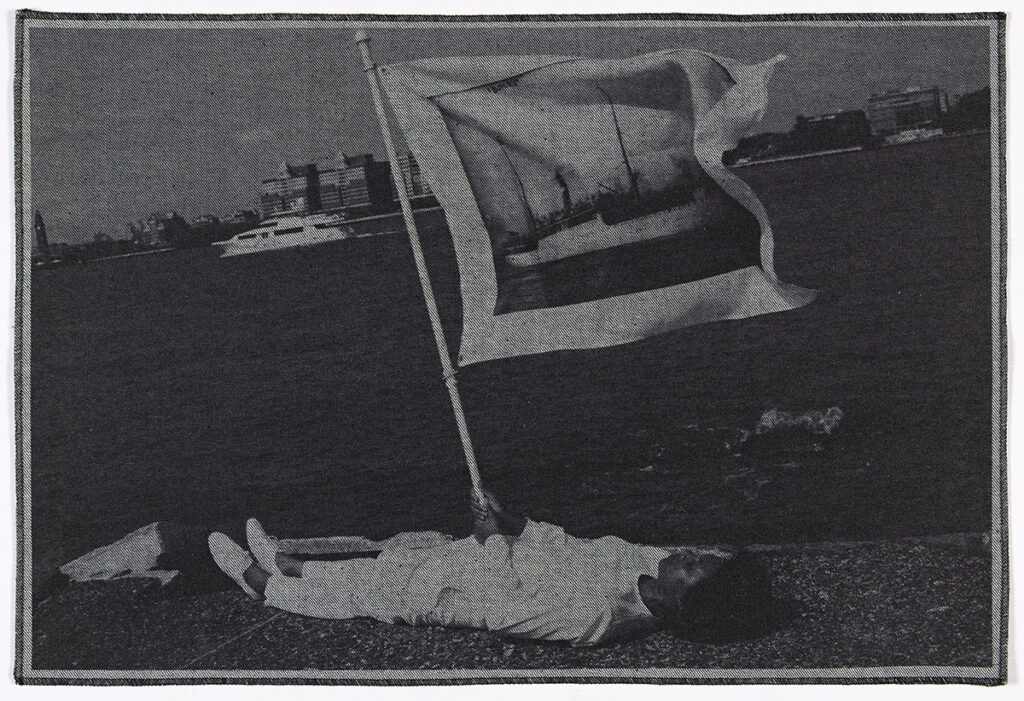
Image: LaToya Ruby Frazier, Holding flag laying at the edge of Pier 54 and the Hudson River., 2014 (printed 2016). U.V. digital print on denim, 16 1/2 x 24 3/8 in, edition 10/25 printed and published in 2016 by Carré d’Art, Nimes, France. Weatherspoon Art Museum, UNC Greensboro. Museum purchase with funds from Louise D. and Herbert S. Falk Acquisition Endowment, 2025; 2024.30. © LaToya Ruby Frazier, courtesy of the artist and Gladstone Gallery, New York
For more information or press images, contact: Elaine D. Gustafson, Curator of Collections, edgustaf@uncg.edu, 336-256-1454
About the Weatherspoon Art Museum
Mission
Embracing its public service role, the Weatherspoon Art Museum at UNC Greensboro fosters the ability of art to impact lives and connect multiple communities.
History
The Weatherspoon Art Museum at UNC Greensboro was founded by Gregory Ivy in 1941 and is the earliest of any art facilities within the UNC system. The museum was founded as a resource for the campus, community, and region, and its early leadership developed an emphasis—maintained to this day—on presenting and acquiring modern and contemporary works of art. A 1950 bequest from the renowned collection of Claribel and Etta Cone, including prints and bronzes by Henri Matisse and other works on paper by American and European modernists, helped establish the Weatherspoon’s permanent collection. During Ivy’s tenure, other prescient acquisitions included a 1951 suspended mobile by Alexander Calder, Willem de Kooning’s pivotal 1949-50 Woman, and the first drawings by Eva Hesse and Robert Smithson to enter a museum collection.
In 1989, the museum moved into its present location in the Anne and Benjamin Cone Building designed by the architectural firm Mitchell Giurgola. The museum has six galleries and a sculpture courtyard with over 17,000 square feet of exhibition space. The American Alliance of Museums first accredited the Weatherspoon in 1995 and renewed its accreditation most recently in 2025.
Collections + Exhibitions
The collection of the Weatherspoon Art Museum is one of the foremost of its kind in the Southeast. It represents all major art movements from the beginning of the 20th century to the present. Among the nearly 7,000 works in the collection are pieces by such prominent figures as Henry Ossawa Tanner, Edward Weston, Joseph Stella, David Smith, Jackson Pollock, Elizabeth Catlett, Louise Nevelson, Gordon Parks, Sol LeWitt, Robert Mangold, Cindy Sherman, Adrian Piper, Betye Saar, Amy Sillman, Nick Cave, Jennifer Steinkamp, and Sanford Biggers. The museum regularly lends to major exhibitions nationally and internationally.
The Weatherspoon is also known for its dynamic exhibition program. Through a lively annual calendar of exhibitions and a multidisciplinary educational program for audiences of all ages, the museum provides an opportunity for visitors to consider artistic, cultural, and social issues of our time—enriching the life of our university, community, and region.
About UNC Greensboro
UNC Greensboro is a learner-centered public research university with nearly 13,000 students in eight colleges and schools pursuing more than 150 areas of undergraduate and 200 areas of graduate study. Recognized nationally for helping first-generation and lower-income students find paths to prosperity, UNCG is ranked No. 1 most affordable institution in North Carolina for net cost by the New York Times and No. 1 in North Carolina for social mobility by the Wall Street Journal. Designated an Innovation and Economic Prosperity University by the Association of Public and Land-grant Universities, UNCG is a community-engaged research institution with a portfolio of more than $67M in research and creative activity. The University creates an annual economic impact for the Piedmont Triad region in excess of $1B. Please visit uncg.edu and follow us on Facebook, X, Instagram, Bluesky and LinkedIn.
Weatherspoon Art Museum
UNC Greensboro
1005 Spring Garden Street
Greensboro, NC 27412, 336-334-5770, weatherspoon@uncg.edu